

A New Chapter for Brain Surgery
For decades, artificial intelligence in healthcare has largely worked behind the scenes—analysing medical scans, identifying patterns in patient data and helping doctors make predictions.
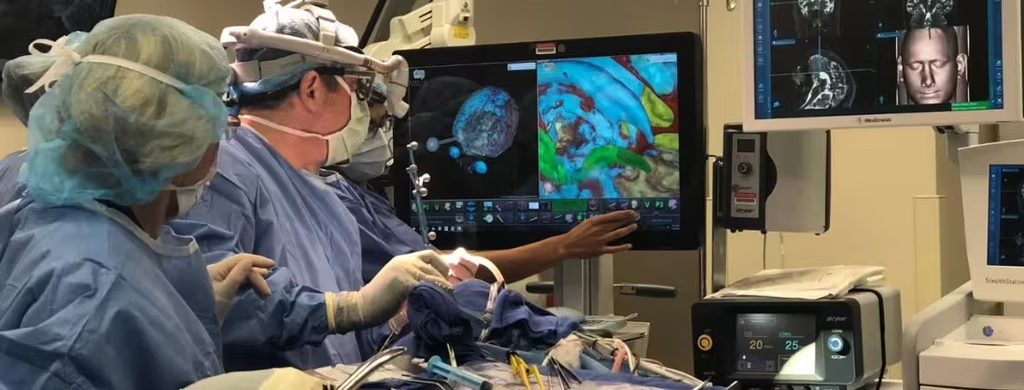
Now, AI is stepping into one of the most complex and demanding environments in medicine—the operating room. AI in Brain Surgery is opening up new possibilities for how surgeons plan, navigate and perform delicate brain procedures, while helping them make more informed decisions during surgery.
In August 2026, researchers and surgeons at University College London (UCL) and University College London Hospitals (UCLH) reported the first use of an AI system designed to support a neurosurgeon in real time during a live brain operation.
The procedure involved the removal of a pituitary tumour from a patient whose vision was being threatened.
The significance is not that a machine performed the operation.
It didn’t.
A neurosurgeon remained in control.
Instead, AI analysed the live surgical video and helped highlight important anatomical structures while the surgeon was operating.
That distinction could be one of the most important developments in the future of AI-assisted surgery.
The Breakthrough: What Actually Happened?
The operation took place at the National Hospital for Neurology and Neurosurgery (NHNN), UCLH, as part of a clinical trial.
The first patient was 48-year-old Rhys Hibbert from Bedfordshire, who had an approximately 11 mm tumour in his pituitary gland.
His tumour was affecting his vision and, without treatment, could have continued to threaten his eyesight.
During the operation, an AI system developed at UCL analysed the live video feed from the surgical procedure.
Rather than simply providing information from scans taken before surgery, the system was designed to recognise important structures visible during the operation.
The objective was to help the surgical team identify critical anatomy and areas where extra caution was required while removing the tumour.
The UCL team says the technology was developed using hundreds of annotated endoscopic pituitary surgery videos and runs on an NVIDIA Clara IGX platform designed for real-time AI applications in medical settings.
In simple terms
The AI did not operate on the patient’s brain.
It watched the live surgical video, recognised important anatomical structures and provided information to support the neurosurgeon during the procedure.
Why Is This Such a Big Deal?
Brain surgery is one of the most technically demanding areas of medicine.
The surgeon may have to work around structures where even a very small error can have serious consequences.
In pituitary surgery, the challenge is particularly significant because the pituitary gland sits close to important blood vessels and the nerves responsible for vision.
This means the surgeon has to constantly balance two objectives:
Remove as much of the tumour as possible.
while
Protecting healthy and critical structures.
Traditionally, surgeons rely on years of training, experience, pre-operative imaging and what they can see during the operation.
Real-time AI introduces another potential source of information.
It can continuously analyse the surgical video and identify structures based on patterns it has learned from previous surgical cases.
That doesn’t replace surgical judgement.
It potentially augments it.
What happened to the Patient ?
The technology becomes easier to understand when viewed through the experience of the first patient.
Rhys Hibbert’s pituitary tumour was discovered after he collapsed during a walk and suffered a seizure in December 2024.
Further investigations revealed the tumour.
Over time, his condition began affecting his vision.
He described repeatedly tripping because he had lost part of his peripheral vision and eventually began using walking sticks.
He decided to undergo surgery and agreed to participate in the clinical trial.
Following the operation, UCL reported that Rhys experienced a dramatic improvement in his vision. Within a week, he was walking independently without glasses or sticks.
How Does AI Assist During Brain Surgery?
The concept may sound futuristic, but the underlying idea is relatively straightforward.
1. The surgical camera captures the procedure
In minimally invasive pituitary surgery, surgeons use an endoscope to see the area being operated on.
2. AI analyses the live video
The AI system processes the video feed while the operation is taking place.
3. The system identifies important anatomy
Using patterns learned from previously annotated surgical videos, the system can help recognise structures such as the pituitary gland, blood vessels and nerves.
4. Information is presented to the surgical team
The purpose is to give the surgeon additional information about what is visible in the surgical field.
5. The surgeon makes the decision
The surgeon remains responsible for interpreting the information and deciding what to do.
This last step is critical.
AI provides assistance. The surgeon provides clinical judgement.AI vs Surgeon: Who Is Actually in Control?
There is sometimes a misconception that AI-assisted surgery means a robot is independently performing an operation.
That is not what happened in this case.
The UCL system is being evaluated precisely because researchers still need to determine how useful, safe and reliable real-time AI assistance is in actual clinical practice. The clinical trial is intended to assess feasibility, safety and clinical outcomes.
Can AI Replace a Neurosurgeon?
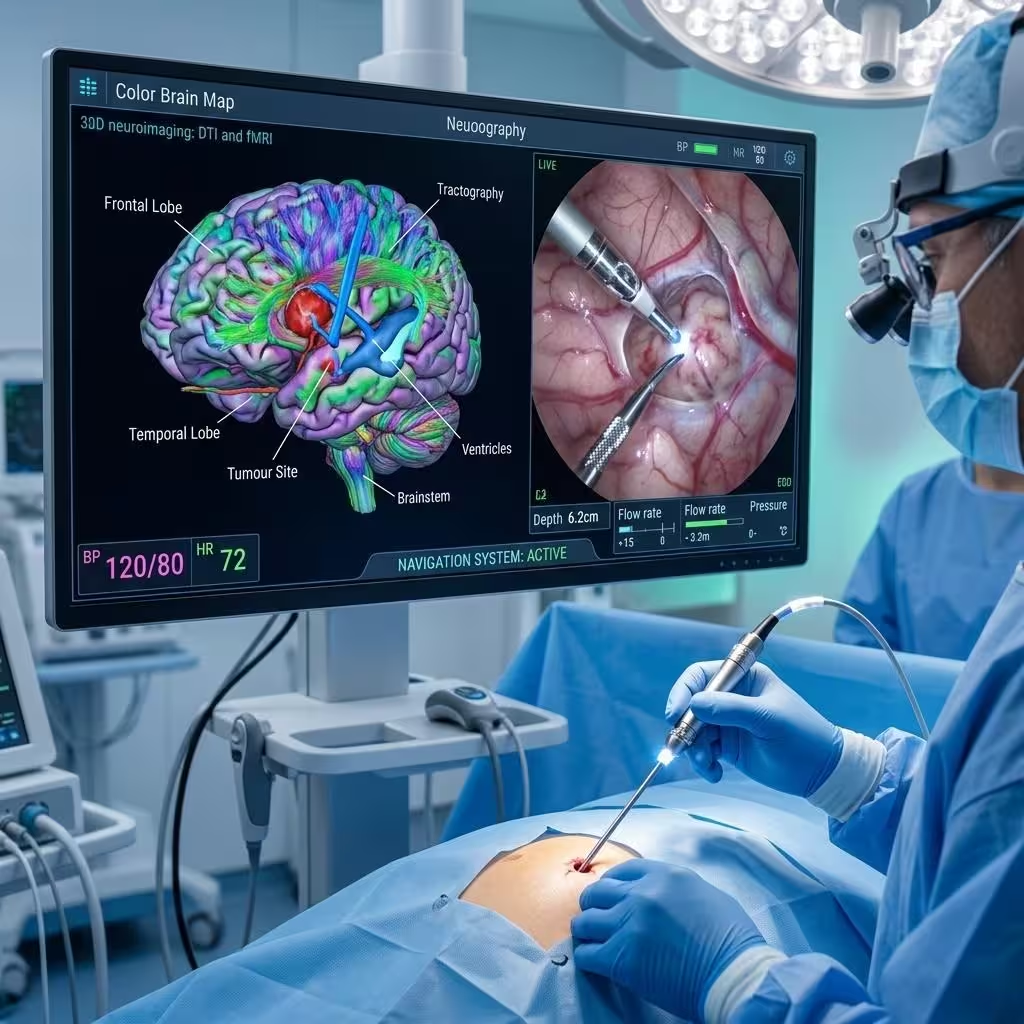
Not based on this technology—and that is not the goal.
Surgery involves much more than recognising structures in a video.
A neurosurgeon must consider:
AI can analyse information extremely quickly, but clinical decisions require context.
The future is therefore more likely to be about human expertise enhanced by intelligent technology rather than humans being removed from the operating room.
What Could This Mean for Patients?
If real-time AI-assisted surgery proves safe and effective through clinical trials, its potential applications could be significant.
Greater anatomical awareness
AI may help surgeons identify important structures during complex procedures.
Additional decision support
Real-time information could potentially complement the surgeon’s own visual assessment and experience.
Surgical training
The same type of technology could eventually help train surgeons by showing anatomy, instruments and surgical interactions in greater detail.
More consistent assistance
An AI system trained on large numbers of surgical examples could potentially provide an additional layer of information across different procedures.
But these are potential benefits, not guarantees.
More clinical evidence is needed before patients should assume that AI-assisted surgery is safer or better for every operation.
The Limitations: AI in Surgery Still Has a Long Road Ahead
Exciting technology can easily create unrealistic expectations.
Real-time AI in surgery faces several important challenges.
Accuracy
An AI system must recognise anatomy reliably under changing surgical conditions.
Uncertainty
AI systems can make mistakes. Surgeons need to understand when the system is confident—and when it may be uncertain.
Clinical validation
Technology that works in a research environment still needs rigorous evaluation in real patients.
Patient safety
Any AI system used during surgery must meet demanding safety and regulatory requirements.
Human oversight
The surgeon must remain able to question, ignore or override AI-generated information.
This is why the UCL project is being conducted as a clinical trial rather than simply being introduced as routine surgical technology.
What Does This Mean for India?
India has one of the world’s largest and most diverse healthcare systems.
At the same time, access to highly specialised medical expertise remains uneven.
Technologies that can support specialist doctors, improve surgical planning or assist medical teams could eventually have an important role in expanding the reach of expertise.
But technology alone cannot solve the healthcare access problem.
India will also need:
The opportunity is particularly interesting for complex medical conditions where patients may need access to specialists who are not available locally.
The Bigger Picture: AI Is Becoming a Healthcare Assistant
Brain surgery is only one part of a much larger transformation.
AI is already being explored across healthcare for:
AI is already being explored across healthcare for:
- Medical imaging
- Cancer detection
- Surgical planning
- Patient risk prediction
- Pathology
- Drug discovery
- Clinical decision support
- Medical documentation
- Remote healthcare
- Personalised medicine
Research is also exploring AI-assisted analysis of surgical video and other intraoperative information. However, performance in research settings does not automatically translate into safe, effective clinical use.
The most interesting future may therefore not be “AI versus doctors.”
It may be:
Doctors with better tools.
Also Read- Best Cancer Hospitals in Bareilly | Oncologists
What Patients Should Remember
Medical technology is advancing rapidly—but patients should not choose a treatment simply because it involves AI.
When facing a complex diagnosis or surgery, the most important questions remain:
- What is my diagnosis?
- Is surgery really necessary?
- What are my treatment options?
- What are the risks and expected benefits?
- What does an experienced specialist recommend?
And when the decision is complex:
Would a second specialist opinion help me make a more informed choice?
Technology can support medicine.
But informed decisions still require qualified healthcare professionals and meaningful conversations with patients.
Doctor Hippo’s Perspective
At Doctor Hippo, we believe healthcare innovation should ultimately be judged by one question:
Does it help patients receive better, safer and more informed care?
AI-assisted surgery is an exciting example of how technology may support specialists in some of the most complex areas of medicine.
But innovation should complement medical expertise—not replace it.
For patients facing major surgery or a complex diagnosis, seeking an expert second opinion can provide another perspective and help them understand their options before making an important decision.
Doctor Hippo helps patients connect with specialist doctors for second opinions and surgery guidance.
Frequently Asked Questions
Is AI performing brain surgery?
No. In the UCL–UCLH procedure reported in August 2026, AI supported the neurosurgeon by analysing live surgical video and highlighting important structures. The surgeon remained in control of the operation.
Was this the first use of AI during live brain surgery?
UCL described the procedure as the first use of AI to support a neurosurgeon in real time during live surgery. It was conducted as part of a clinical trial.
What type of tumour was removed?
The first patient had an approximately 11 mm tumour involving the pituitary gland. The tumour was threatening his vision.
Can AI replace a brain surgeon?
Current AI-assisted surgical systems are designed to support clinicians rather than independently replace them. Human clinical judgement and surgical control remain essential.
Is AI-assisted surgery available for everyone?
Not necessarily. Technologies such as the UCL system are still being evaluated, and availability will depend on clinical evidence, regulatory approval and adoption by healthcare institutions.
The Future of Surgery May Be Human + AI
The operating room of the future may look very different from the operating room of today.
Surgeons may have intelligent systems continuously analysing images, recognising anatomy and providing additional information during complex procedures.
But the most important part of that future may not be the technology itself.
It may be the partnership between human experience and machine intelligence.
The first AI-assisted neurosurgical procedure at UCL/UCLH is an early step in that direction.
It is not the story of a machine replacing a surgeon.
It is the story of technology learning how to stand beside one.
Medical Disclaimer
This article is intended for general health and educational information only. It does not provide medical diagnosis, treatment or individual medical advice. Patients should consult a qualified healthcare professional for advice relating to their specific medical condition. AI-assisted surgical technologies are evolving and may not be appropriate or available for every patient or procedure.